
Growing Through Acquisition? Make Sure Your Back Office Can Keep Up
By David Tell


Growth through acquisition can be one of the most effective ways for automotive dealership groups to expand market presence, increase revenue, and build long-term enterprise value. Adding rooftops can create economies of scale, strengthen regional market share, and position an organization for future growth. But closing the transaction is only the beginning.
The real test often comes after the deal closes, when the organization must integrate another accounting office, set of processes, chart of accounts, reporting structure, and potentially a dealer management system (DMS).
For dealership groups pursuing continued expansion, one question becomes increasingly important: Can the finance and accounting function scale as quickly as the organization is growing?
Growth Can Expose Weaknesses in the Back Office
A dealership group may operate effectively with two or three rooftops using processes that have developed organically over time. Add several more locations, however, and those same processes can become difficult to manage.
Each acquired dealership brings its own way of operating. One store may reconcile schedules daily while another waits until month-end. Financial statements may be structured differently. Reconciliation procedures may vary. Responsibilities may overlap or, in some cases, fall through the cracks entirely.
None of these differences necessarily suggests that an acquired dealership was poorly managed. They simply reflect the reality that successful organizations often develop unique processes over time.
The challenge begins when those different processes must operate together within a single dealership group. If finance infrastructure does not evolve alongside the organization, growth can place increasing pressure on reporting, internal controls, staffing, and management visibility.
Standardization Does Not Mean Uniformity
One of the first priorities following an acquisition should be establishing consistency across the finance and accounting function. That does not mean every dealership must operate identically. Different brands, markets, and operating environments will always require some level of flexibility. Standardization is not about eliminating local decision-making. It is about creating a common financial foundation that allows leadership to understand performance across the enterprise.
Areas that often require standardization include:
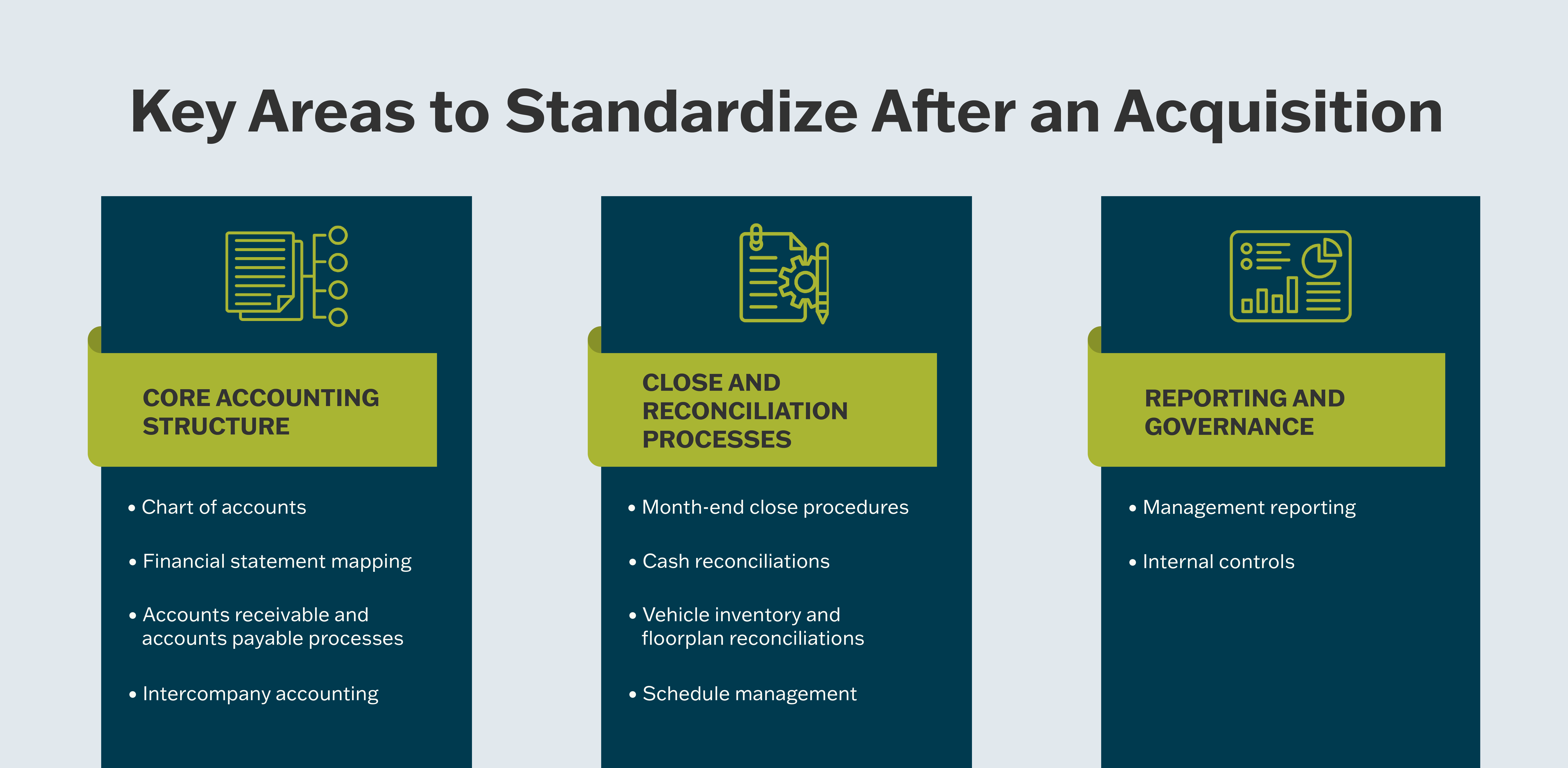
Without that consistency, consolidated reporting becomes more difficult and meaningful comparisons between rooftops become less reliable. Leadership should be able to identify where performance is strong, where issues are emerging, and where management attention is required. As the number of rooftops grows, visibility becomes increasingly important.
The Risk of an Unprepared Accounting Function
When the back office cannot keep pace with growth, warning signs often appear quickly. Month-end closes take longer. Reconciliations remain incomplete. Financial statements require increasing numbers of post-close adjustments. Intercompany balances become difficult to resolve. Eventually, management spends more time determining whether information is accurate than using it to make business decisions.
The consequences extend beyond administrative inefficiency. Delayed or inconsistent financial reporting can prevent leadership from identifying operational challenges early enough to address them. Profitability opportunities may be missed. Cash flow issues can remain hidden. Operational problems can persist longer than they should.
In a growing dealership organization, the accounting department cannot simply record what happened. It must provide ownership and management with timely, reliable information about what is happening now.
Building an Acquisition-Ready Finance Function
A scalable finance organization begins with strong fundamentals. Documented procedures reduce dependence on institutional knowledge. Standardized processes create consistency across locations. Strong controls help protect the organization as transaction volume increases. Consolidated reporting allows management to evaluate performance across multiple rooftops. Budgeting and forecasting improve visibility into where the organization is heading rather than simply reporting where it has been.
The objective is acquisition readiness: a finance infrastructure capable of absorbing the next acquisition without requiring the organization to rebuild its accounting processes every time another dealership is added.
For many dealership groups, however, building that infrastructure entirely in-house can be difficult. Experienced dealership accounting professionals are not always easy to find. Acquisitions often create immediate resource demands before organizations have sufficient time to recruit, onboard, and train additional personnel.
Evaluating the Right Operating Model
Every dealership group's needs are different. Some organizations require additional transaction-processing support. Others need controller-level oversight or enhanced reporting capabilities. Still others may benefit from outsourcing selected accounting functions or adding specialized expertise during periods of rapid growth. The key is identifying which responsibilities should remain internal and where external resources can provide additional flexibility, capacity, or subject matter expertise.
For organizations experiencing acquisition-driven growth, outsourcing [KE2.1]can be part of that solution. Outsourcing does not necessarily mean replacing an existing accounting department. In many cases, it means strengthening the existing team by supplementing capabilities during periods of transition, integration, expansion, or turnover.
Where Outsourcing Can Support Dealership Growth
An outsourced finance and accounting team can work alongside a dealership group's CFO, controller, ownership team, and accounting staff to provide additional capacity and expertise when needed.
Support may include:
- M&A and Post-Acquisition Support: Helping manage integration demands and the increased accounting workload that often follows a transaction
- Purchase Accounting: Assisting with acquisition-related accounting and financial reporting requirements
- Multi-Rooftop Reporting: Improving visibility and consistency across the organization
- Process Standardization: Establishing common procedures, controls, and expectations
- Controller-Level Support: Providing experienced oversight when internal leadership resources are stretched
- Accounting Office Support: Supplementing resources during acquisitions, turnover, system conversions, and periods of rapid expansion
The primary advantage is scalability. Rather than building an accounting department solely for today's organization, dealership groups can develop a finance model capable of expanding as the business grows.
Is Your Organization Ready for the Next Acquisition?
Before pursuing the next transaction, dealership leadership should consider several important questions:
- Can the organization produce timely and consistent financial reporting across all rooftops?
- Are month-end close procedures and reconciliation requirements clearly documented?
- Can intercompany balances be identified and resolved efficiently?
- Are critical accounting processes dependent on one or two individuals?
- Does the accounting function have the capacity to integrate another dealership without disrupting existing operations?
The answers can provide valuable insight into whether the finance organization is positioned to support continued growth.
Growth Should Strengthen Financial Visibility
Acquisition growth should create opportunities, not uncertainties. As dealership groups grow larger and more complex, their finance and accounting functions must become stronger, more standardized, and more scalable. The objective is not simply to close the books. It is to provide ownership and management with confidence that the financial information they receive is timely, accurate, and useful for making decisions.
Closing the deal is an important milestone. Building an organization that operates successfully after the acquisition is the real measure of growth.
Citrin Cooperman’s Dealership Industry Practice works with dealership organizations to strengthen finance and accounting operations, improve reporting visibility, standardize processes, and provide scalable resources during periods of growth and transition. To start the journey of strengthening your dealership’s finance and accounting operations, contact David Tell.
Latest Articles

Bigger Deals, More Complex Reporting: How Real Estate Sponsors Can Stay Ahead
Read More

Operational Due Diligence: What Investors Are Really Looking For
Read More

Why QuickBooks Reporting Gets Harder as Your Business Grows
Read More

A Clean Start: Why Accounting Data Matters at NetSuite Cutover
Read More