
How Salesforce Maps Helps Sales Teams Work Smarter and Drive User Adoption
By Molly Henry


Salesforce Maps is a powerful yet often underutilized component of the Salesforce platform. Available as an add-on to Sales Cloud, Service Cloud, Retail Execution, and other industry solutions, it enables organizations to leverage GPS-based location data to improve visibility, streamline operations, and enhance sales performance.
Equally important, tools like Salesforce Maps can play a critical role in driving Salesforce user adoption by embedding intuitive, daily-use functionality directly into sales workflows.
At its core, Salesforce Maps allows users to plot both internal and external data on interactive maps directly within Salesforce. Data is displayed in configurable “layers,” which are built using filters to highlight specific records. For example, a user can create a layer that displays accounts within a particular revenue range, such as $1–5 million, and within a defined geographic area based on zip codes.
Map points can be customized with different colors and shapes to help users quickly interpret and distinguish data — making complex information more accessible and actionable.
Key Capabilities and Use Cases
Data Visualization
Sales teams use Salesforce Maps to better understand their territories and identify opportunities. By visualizing accounts, contacts, and leads geographically, they can pinpoint coverage gaps, uncover clusters of potential business, and prioritize high-growth regions.
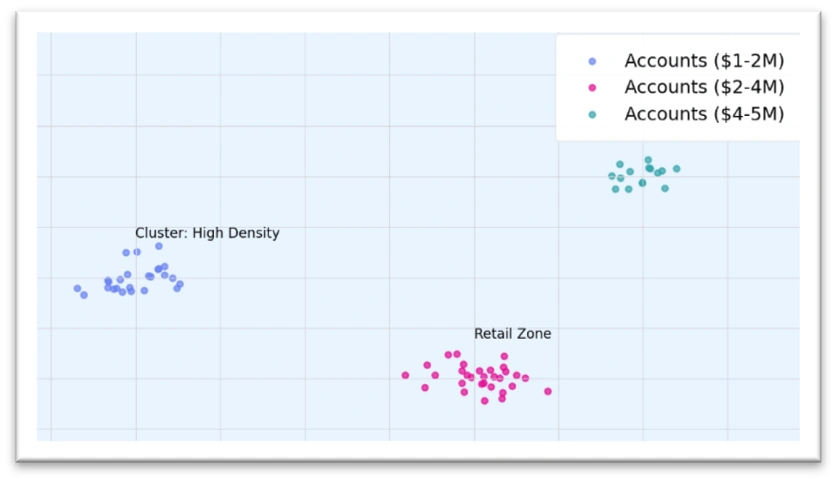
Tools like this also improve user adoption by replacing static reports and spreadsheets with interactive, visual insights that are easier to consume and act on. In addition to Salesforce data, organizations can integrate third-party sources. For example, a large tire manufacturer used ERP data to create map layers that helped sales representatives plan and organize customer visits across the country.
Route Optimization
Salesforce Maps includes built-in route planning functionality that enables users to efficiently schedule customer visits. Sales representatives can select multiple locations from a data layer and add them to their daily schedule. The system then generates optimized routes to minimize travel time and maximize productivity.
Because this capability directly supports day-to-day activities, it naturally reinforces Salesforce adoption — users rely on the platform not just for reporting, but for executing their work. An organic beverage company, for instance, uses this feature to map retail locations where its products are sold. Field representatives rely on Maps to plan store visits, manage their routes, and track activity throughout the day.
Lead Generation
Salesforce Maps also supports prospecting and lead generation efforts. By incorporating third-party data providers such as ATTOM or DatabaseUSA.com, organizations can enrich their maps with demographic or property data. Sales teams can then identify and target new prospects based on geographic and socioeconomic factors, enabling more focused and effective outreach.
This type of functionality helps position Salesforce as a revenue-generating tool, an important factor in driving long-term user engagement and adoption.
Mobile Accessibility
Designed with mobility in mind, Salesforce Maps is fully accessible on mobile devices. Field representatives can use their smartphones to view maps, plan routes, and update records in real time. This eliminates the need for a laptop in the field and ensures that teams remain productive and connected throughout the day.
Mobile-first capabilities further strengthen user adoption by meeting employees where they work, reducing friction and encouraging real-time data entry.
Driving Business Value and User Adoption
Salesforce Maps goes beyond simple mapping functionality. It transforms location data into actionable insights that help organizations operate more strategically. By improving territory management, optimizing field activities, and enabling targeted prospecting, businesses can increase efficiency, enhance customer engagement, and drive revenue growth.
At the same time, by delivering clear, immediate value to end users, Salesforce Maps helps organizations overcome one of the most common challenges in CRM initiatives: driving consistent user adoption. When sales teams see direct benefits in their daily workflows, they are more likely to engage with the platform, maintain accurate data, and fully leverage Salesforce’s capabilities to grow their business.
Looking to Get More from Salesforce? Our Salesforce Solutions team combines deep platform expertise with real-world experience to help you optimize performance, drive meaningful user adoption, and scale with confidence. From aligning Salesforce to your business processes to unlocking underutilized capabilities like Salesforce Maps, we collaborate with you to turn your investment into measurable results.
Latest Articles

Pressure-Testing Your Construction Deal Thesis: Validating Assumptions Before You Buy
Read More

Treasury and IRS Propose Regulations on Racial Nondiscrimination Requirements for Private Schools
Read More

Part 2: Risk Management as a Value Creation Lever: Measuring Risk's Impact on Enterprise Value
Read More

Part 1: Risk Management as a Value Creation Lever: Why Private Equity is Rethinking Risk
Read More