
Part 2: Risk Management as a Value Creation Lever: Measuring Risk's Impact on Enterprise Value



Part 1 of this series examined how effective risk management contributes to enterprise value by protecting earnings, supporting growth, strengthening resilience, and improving transaction outcomes. However, recognizing value is only part of the equation. Organizations must also be able to measure, quantify, and communicate the impact of risk management in a clear and meaningful way.
If risk management contributes to enterprise value, it should be measured and evaluated like any other value creation initiative.
Most organizations have invested significantly in risk management capabilities, yet many still struggle to articulate the business impact of those investments. Boards and executive teams regularly receive updates on risk assessments completed, policies implemented, controls tested, and employees trained.
While these activities are important, they rarely address what matters most to private equity investors and prospective buyers: the extent to which risk management protects revenue, preserves EBITDA, strengthens organizational resilience, and enhances transaction readiness and valuation.
Demonstrating that impact requires a shift from activity-based reporting to outcome-based measurement. Rather than focusing on what risk management does, organizations must quantify the business outcomes it enables and the value it contributes.
From Activity Metrics to Business Outcomes
Traditional risk reporting tends to focus on activities, such as policies updated, assessments completed, and controls tested. While these metrics demonstrate effort and program maturity, they provide limited insight into business impact.
What matters most to boards, investors, and executive teams is whether risk management is helping protect growth, preserve earnings, strengthen operational resilience, and support successful transaction outcomes. Measuring that impact requires looking beyond activities and focusing on outcomes.
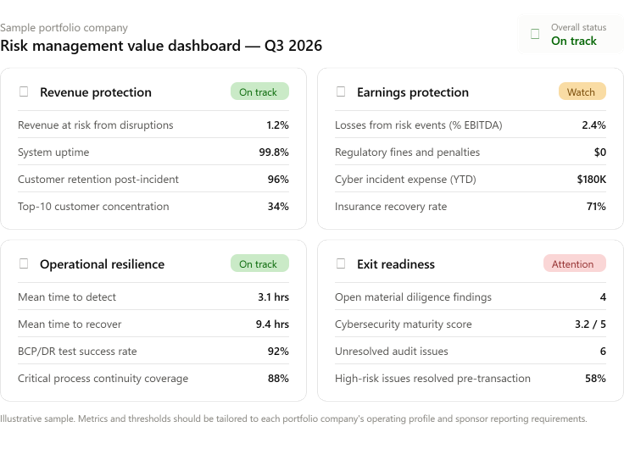
An effective risk dashboard should therefore concentrate on the areas where risk management can have the greatest influence on enterprise value: revenue protection, earnings protection, operational resilience, and exit readiness.
-
Revenue Protection
Revenue protection measures how disruptions affect a company’s ability to generate and keep revenue. The goal is to understand the impact of risk events on operations, customer relationships, and business growth.
Key metrics may include revenue affected by disruptions, system uptime, customer retention after major incidents, supplier and customer concentration, and the number and severity of business interruptions.Tracking these metrics over time can help identify emerging risks and assess the effectiveness of mitigation efforts. -
Earnings Protection
Earnings protection should be evaluated through metrics that quantify the financial impact of risk events on profitability. The objective is to measure how well risk management reduces losses, controls unexpected costs, and protects EBITDA.
Relevant metrics include losses from risk events as a percentage of EBITDA, regulatory fines, compliance penalties, litigation costs, fraud losses, cybersecurity incident expenses, insurance recoveries, and business interruption losses. Monitoring these measures over time helps organizations understand earnings volatility and the value of risk management in protecting profits. -
Operational Resilience
Operational resilience measures an organization’s ability to withstand, respond to, and recover from disruptions while maintaining critical operations.
Key metrics may include mean time to detect, respond to, and recover from incidents; business continuity and disaster recovery testing success rates; recovery objective achievement rates; continuity plan coverage for critical processes; and third-party risk assessment coverage. Organizations may also monitor the duration and operational impact of significant disruptions to identify improvement opportunities. -
Exit Readiness
Exit readiness assesses how prepared an organization is for a transaction or ownership change from a buyer’s due diligence perspective. The objective is to quantify potential transaction risks before they are identified by a buyer.
Key metrics may include material diligence findings, cybersecurity maturity scores, unresolved audit issues, compliance gaps, control effectiveness ratings, remediation timelines, and governance maturity assessments. Organizations may also track the percentage of high-risk issues resolved before a transaction to demonstrate readiness and reduce deal-related risks.
Individually, these metrics provide insight into specific areas of risk. Collectively, they tell a broader story about how risk management influences enterprise value. By focusing on measurable business outcomes rather than activities or outputs, they help organizations quantify outcomes.
Building a Portfolio-Wide Approach to Risk Management
Rather than having each portfolio company approach risk management differently, private equity sponsors can establish a common framework that standardizes key metrics, definitions, and reporting practices across the portfolio. Standardized dashboards, reporting schedules, and risk-rating methodologies create consistency and allow sponsors to benchmark performance, identify emerging risks, prioritize investments, and track progress over time.
This broader perspective allows sponsors to identify emerging risks earlier, compare performance across portfolio companies, and allocate resources more effectively. It also creates a common language for discussing risk across the portfolio, improving oversight and enabling more informed investment decisions.
Measure What Matters
The most effective risk programs are not necessarily the ones that generate the most reports or track the greatest number of activities. They are the ones that can clearly demonstrate business impact.
As discussed in Part 1, private equity investors are increasingly viewing risk management as a core component of value creation rather than simply a protective function. By pairing that strategic perspective with meaningful outcome-based measurement, organizations can move beyond managing risk and to being able to demonstrate a tangible contribution to enterprise value throughout the investment lifecycle.

Latest Articles

Bigger Deals, More Complex Reporting: How Real Estate Sponsors Can Stay Ahead
Read More

Operational Due Diligence: What Investors Are Really Looking For
Read More

Why QuickBooks Reporting Gets Harder as Your Business Grows
Read More

A Clean Start: Why Accounting Data Matters at NetSuite Cutover
Read More