
Why Relationships, Not Price, Will Define Growth in Manufacturing
By Christopher Hunter


In a market defined by tariff volatility, persistent labor shortages, and margin compression, manufacturers and distributors are looking for any possible advantage. Most efforts are pointed inward – cutting costs, optimizing supply chains, or upgrading technology stacks. But Citrin Cooperman's 2026 Manufacturing and Distribution Pulse Survey Report (“the Report”) highlights an area that deserves equal attention: the strength of customer and supplier relationships may be the most underutilized competitive asset.
What Respondents Believe Is Most Important to Customers
(source: The Report page 17)
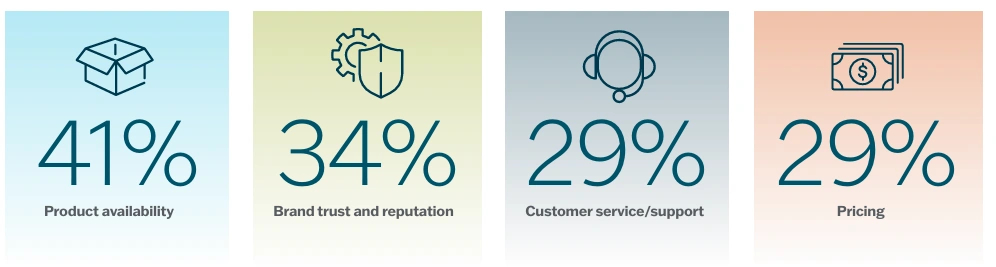
When respondents were asked what matters most to customers, product availability ranked first at 41%. Brand trust followed at 34%, while customer service and support tied with pricing at 29%.
Pause on that last point. Pricing — the factor companies instinctively compete on — tied for third. Customers are signaling that reliability, trust, and responsiveness matter more. Compared to those priorities, price is almost secondary.
What Respondents Believe Is Most Important to Suppliers
(source: The Report page 18)
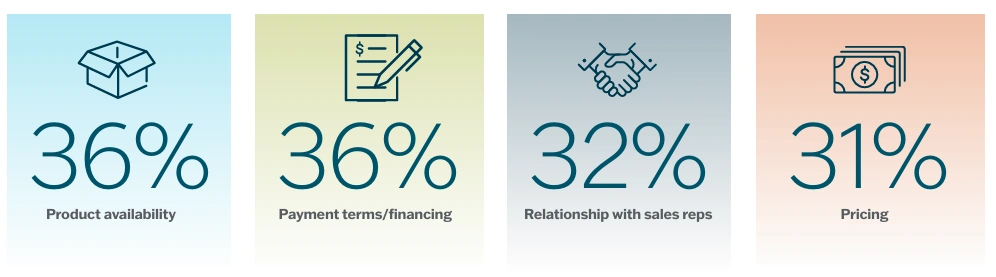
The same message carries through on the supplier side. Product availability and payment terms tied as top priorities at 36%, followed closely by relationships with sales representatives at 32%. In other words, suppliers are asking for trusted relationships and operational reliability. Not just competitive pricing or order volume.
This is a meaningful signal for any manufacturing or distribution leader. The businesses that will win in 2026 and beyond are not necessarily the ones with the lowest cost structure. They are the ones whose customers trust them to deliver and whose suppliers prioritize them when things get tight.
The Gap Between Customer Expectations and What Businesses Can Deliver
The Report identifies supply chain disruptions, rising inflation, and the high cost of capital as the top challenges facing manufacturers and distributors. These pressures create a difficult dynamic: at the moment when customers need reliability most, businesses are under the greatest internal strain to provide it.
Labor shortages continue to slow fulfillment, while inventory stockpiling ahead of tariffs has tightened cash flow. Finance and accounting teams are stretched thin, making it harder to provide accurate updates on orders, payments, and pricing. Notably, 96% of respondents reported labor shortages in 2025, with warehouse and skilled roles most affected.
When teams are operating at capacity, communication with customers and suppliers is often the first area to break down.
This leads to a growing credibility gap. Customers expect steady product availability and responsive service. Suppliers expect consistent payment and proactive engagement. Yet operational pressure makes it difficult to meet these expectations consistently.
Importantly, this is not a strategy issue. Most leadership teams understand what their customers and suppliers need. The challenge lies in execution and visibility, and that is where the right technology can make a meaningful difference.
Relationships at Scale Require a Strong Foundation
Manufacturers and distributors that consistently meet expectations tend to share a common foundation: they have systems that deliver the right information to the right people at the right time. Sales representatives can see a customer’s order history, open issues, and pricing agreements before starting a conversation. Customer service teams have real-time visibility into inventory and shipment status. Supplier relationships are managed proactively, with fewer surprises.
This does not replace the human element. The Report establishes that relationships with sales representatives remain a top priority for both customers and suppliers. Personal connections still matter deeply in this industry.
The real question is whether your team’s relationships are scalable and consistent across the entire business, not just limited to the accounts your strongest representatives manage most closely.
Consider how this plays out day to day.
- When a sales rep leaves, does their knowledge walk out the door with them?
- When a customer calls with an issue, does your service team have full context — or are they rebuilding the story from scratch?
- When a supplier asks about payment status, can someone answer instantly, or does it trigger a hunt through emails and spreadsheets?
These are the moments when relationships are won or lost, and they occur dozens of times each day across your organization.
What a Connected Platform Makes Possible
A modern CRM platform that unifies customer data, supplier data, service history, order information, and communications into a single view can significantly improve how teams operate. With a complete picture, sales representatives enter every conversation fully informed. Service teams can quickly resolve issues because they see the full relationship history, rather than piecing together information from different sources. At the same time, leadership gains early insight into which relationships are strong and which may be at risk, well before renewal conversations become urgent.
The same benefits extend to suppliers. When payment terms, contract history, ownership, and communication records are centralized, procurement and finance teams can manage supplier relationships with the same level of consistency and discipline that sales teams bring to customer relationships.
The Report highlights that businesses are increasingly recognizing that data, not systems, is the true differentiator. This is particularly evident in relationship management. Organizations that can deliver the right information at the right time and equip their teams to act on it are the ones most likely to build and sustain trust over time.
The Competitive Moment
The Report makes it clear that growth is slowing. While net revenue is still increasing, gains are more modest than in prior years, with significant growth falling from 49% in 2024 to just 15% in 2026. In this environment, retention becomes a primary driver of growth. Expanding relationships with existing customers delivers more value than acquiring new ones, and suppliers who prioritize your business provide a meaningful advantage when supply is tight.
This shifts customer and supplier relationships from a soft metric to a financial one. It also positions the systems that support those relationships as strategic investments rather than operational expenses. Organizations that recognize this and build the right foundation will be the ones that look back on this period of uncertainty as the moment they pulled ahead.
If you are interested in understanding what a modern relationship management platform can look like for manufacturers and distributors, talk to us about where the gaps are in your current approach and we can show you what is possible.
Latest Articles

Cybersecurity Awareness Month: What to Do When Your Identity Is Stolen
Read More

Multi-Entity Accounting in QuickBooks: When Does It Make Sense to Take the Next Step?
Read More

5 Signs Your Business May Be Ready for the Next Step After QuickBooks
Read More