Boosting Performance and Profitability: Staying Ahead of the Curve in the Asset Management Industry



Our 2026 Asset Management Survey Report gathers the responses and insights from 300 asset management leaders across the United States for what is top of mind in the industry, including strengthening performance. Our questions regarding operations range from plans to accept an injection of outside capital into the management company to topics like outsourced solutions, artificial intelligence tools, headcount plans, and challenges to talent attraction and retention. Amid economic uncertainty, survey respondents are considering strategies to sharpen performance and increase profitability.
Outside Capital Actions and Intentions, Past and Future
Outside capital can have a key role as firms work to increase assets under management (AUM), generate more influence and/or boost market share — all of which allows leaders to expand their operations, launch new funds, or enhance profitability. Less than half (42%) surveyed report they have previously taken investments of outside capital in their management company, while two-thirds (65%) plan to take an investment in the future.
The high percentage of asset managers planning to take future investments demonstrates a dynamic industry committed to adapting and transforming in a complex and evolving market. This transformation is driven by technological advancements like AI, evolving investor preferences, regulatory changes, and the constant pressure to enhance profitability and investor satisfaction.
“More managers are interested in taking outside capital to fund operations and growth, and/or to provide a monetization event for its founders. However, prior to engaging in significant discussions around taking on outside investments, managers may need to restructure their management company and general partner entities, convert their books and records from a cash or income tax basis to U.S. GAAP, and undergo a financial statement audit,” says James Catalano, partner, Financial Services Industry Practice.
Affiliated Broker Dealer Usage
Affiliated broker-dealers are used by most of the asset management firms we polled. These relationships are often leveraged to streamline operations, improve regulatory compliance, and expand product and service offerings. Nearly two-thirds of our respondents (65%) have an affiliated broker dealer in place. The most frequently cited use of affiliated broker dealers is to provide investment banking services (68%).
“While asset managers can use an affiliated broker to provide services for a combination of strategic, operational, and financial reasons, it is important to note that this structure introduces potential conflicts of interest that are subject to regulatory scrutiny,” notes Alexander Reyes, partner and Financial Services Industry Practice leader.
Outsourcing Solutions
To help fund leaders create efficiencies and focus on shaping investment strategies and building client relationships, a wide range of fund and management company tasks and functions are handled by leveraging outsourcing. These range from tax and accounting support to information technology, human resources, valuation, and compliance operations. Respondents report the top three tasks and functions outsourced in their firms and funds are fund tax compliance (43%), management company accounting (41%) and fund administration (40%).
Fund tax compliance, management company accounting, and fund administration involve regulatory compliance, risk management, reporting standards, and technology requirements that demand specialized knowledge and tools. By outsourcing these and other services, managers can bypass the need to invest in developing and maintaining these capabilities in-house, allowing them to dedicate more time and resources to managing returns and investor satisfaction. However, maintaining proper oversight of these outsourced services is critical as part of the fund's corporate governance.
The Promise and Purpose of Artificial Intelligence
“AI’s role in asset management is evolving from automation to augmentation. Beyond streamlining reporting and reconciliation, firms are beginning to use AI to surface insights, assess risk, and personalize investor communications — ushering in a new era of intelligent operations,” states Derek Nachimow, partner, Digital and Cloud Services Practice.
In Citrin Cooperman’s 2025 Private Company Performance Report, which spans industries including the asset management field, 71% of respondents say AI-related technologies and initiatives had the most technology-driven business impact over the past three years. For that and other reasons, we are not surprised to see that nearly all asset management survey respondents in this study (99%) are using AI in some form. The most prevalent AI applications in asset management operations today are instructive. The top three are for data analysis including financial reporting (56%), accounting and reporting (52%), and regulatory reporting (44%).
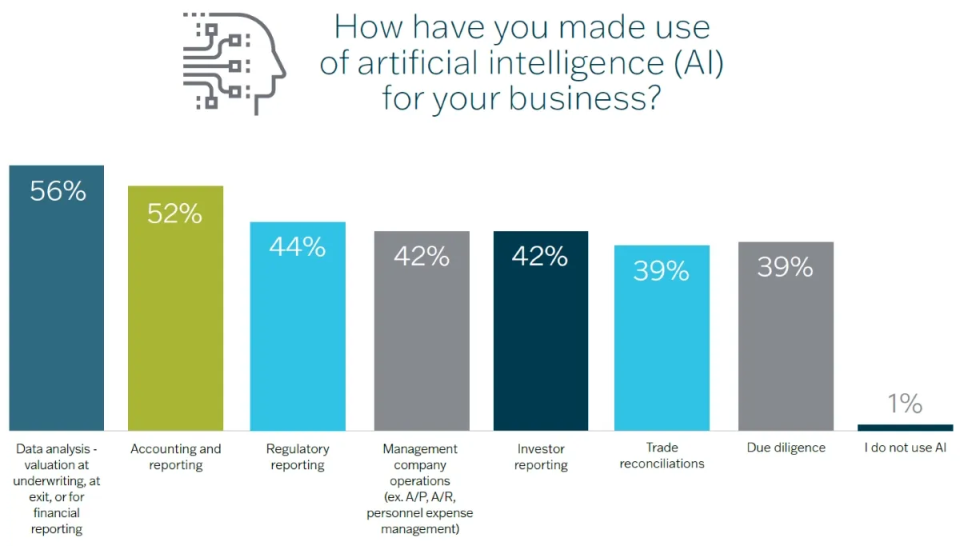
There is a clear increase in use of AI that we believe will continue to be adopted across managers and in new ways and we suspect some of the less cited AI uses like investor reporting and due diligence will trend upwards in the future.
Like any powerful tool, AI can be misused, and cybercriminals are already finding ways to weaponize it. As the asset management industry embraces AI for innovation and efficiency, malicious actors are leveraging the same technology to bypass security systems, deceive individuals, and conduct cyberattacks with unprecedented speed and precision.
Some of the most pressing concerns on how AI empowers cybercriminals and endangers digital security within the financial services industry include:
- Sophisticated fraud and synthetic identity creation
- AI-powered phishing and business email compromise
- AI-driven automated reconnaissance and exploitation
- Adversarial attacks on AI fraud detection systems
- AI chatbot data breaches
- Malicious redirection of expired website domains
Beyond the threat of cyber criminals, end users can also fall into the trap of unintentionally exposing sensitive data by not having proper training and guidelines.
“It is important to invest in robust AI cybersecurity measures and enhance ongoing awareness training to protect the business. By remaining vigilant and proactive, asset management firms can leverage the benefits of AI while minimizing the risks associated with AI-drive cyberattacks,” states Kevin Ricci, partner and co-leader, Internal Audit, IT Audit, and Cybersecurity Practice.
Headcount Plans
Our survey response data reveals a three-way split as it relates to headcount and hiring plans. Market-facing roles, like investment professionals, are broadly projected to increase in the next twelve months — more than half of respondents (56%) say more people in these roles are expected in the year ahead. The balance (44%) predicts no change or decreasing head count.
Forty-eight percent expect an increase in investor relations headcount and 51% foresee no change or a decrease in investor relations staffing.
Meanwhile, internally focused staffing like accounting/finance and compliance/legal roles are expected to maintain at current levels or decreased by most respondents. Only 40% of respondents in our survey say accounting/finance hiring will increase in the next 12 months, and 37% say compliance legal roles will increase.
“The survey findings are consistent with what we see in the market. New product offerings and newly launched funds are prompting the need for more investment professionals. Conversely, managers are employing less investor relations, accounting, and compliance professionals, as these roles are seeing an increase in being filled via outsourcing,” notes James Catalano.
Talent Acquisition and Retention Challenges
As asset managers indicate plans to increase headcount among investment professionals, two in three (65%) report challenges in investment professional talent acquisition and retention. This is not surprising in our experience. The asset management industry, like many sectors facing skills shortages, competes fiercely for a relatively small pool of highly qualified individuals. The consistent poaching of talent between firms and alternative career opportunities makes retention a constant battle.
Citrin Cooperman’s 2026 Asset Management Survey Report