
Strategic Decisions for Successful Restaurants: Labor Costs



In today’s competitive landscape, understanding what separates high-performing restaurants from the others is more important than ever. Citrin Cooperman’s Restaurants and Hospitality Industry Practice has undertaken a comprehensive analysis of over 50 full-service restaurant establishments and assessed the influence of strategic decisions, such as labor costs, on the bottom line.
Our analysis shows that labor costs were managed well by top and mid-performers, remaining relatively flat in 2024 when compared to 2023. Since revenues were down in most establishments, and some labor is inherently fixed, credit is due to the managers that staffed and scheduled their teams in an efficient manner to keep margins in place. Top performers incur labor costs at about 31.5% of revenues, while mid-range performers run at around 36.5%.
Low performers were unable to maintain their labor costs, going from 39.3% of revenue to 40.9%. Labor is and will continue to be the expense area that requires the most attention. There's been consistent momentum for state and local legislators to raise minimum wage, eliminate the minimum wage tip credit, and enforce predictive scheduling requirements, all of which create headwinds on the industry.
The “No Tax on Tips" provision of the recently signed One Big Beautiful Bill Act is expected to improve the employment market for operators, but there are a lot of moving pieces that may make it difficult to manage one way or another. Staying with our example of an establishment doing $10 million in sales, the top performers are yielding an additional $940,000 to the bottom line due to their savings on efficient labor costs.
How the Top Performers Operate
Every operation is going to have some level of labor that is fixed, so regardless of any tips and tricks to keep these costs under control, the establishment needs to be producing a certain level of sales to maintain its profit. Top performers train their staff on techniques to upsell customers on items like cocktails and desserts, and properly time their offerings so that the guests have time to enjoy all courses in a comfortable timeframe, but not too long to prevent the restaurant from turning tables.
Sales aside, the use of technology allows the most efficient operators to monitor their costs so that they can make timely business decisions to keep margins intact. Examples of technology that help control labor costs are:
- Predictive scheduling that encompasses historical info, scheduled events, and weather; and
- Systematized training platforms to cross-train team members to perform multiple roles mitigate the costs of turnover.
Another form of technology that high performing brands are starting to utilize is a flexible service model where guests can use their phones or a tableside kiosk to order another round of drinks or close out their bill without waiting for their server to come around. While this is believed to potentially take away from the traditional hospitality experience, it’s a matter of time before convenience and costs start to pull from comfort and tradition.
How the Low Performers Operate
Low performers are often not managing their overtime or sometimes have too many heads in the back of the house. Low-performing teams are often siloed. No cross-training means more staff are required to cover shifts, and managers have fewer options to fill gaps efficiently.
Lack of accountability will also create inefficiencies. If there’s no visibility into how labor ties to performance, managers aren’t incentivized to optimize schedules, and staff aren’t coached on productivity. Also worth noting is the cost of turnover. High turnover is inevitable in the restaurant industry, but there's a steep cost to having to train the same role multiple times per year — keeping employees satisfied and incentivized can save quite a bit.
Trends
States and cities continue to pass legislation that substantially increases their minimum wage, phases out their minimum wage tip credit, or sets forth requirements that otherwise result in more labor such as predictive scheduling or employee benefits requirements.
The “No Tax on Tips” provision of the One Big Beautiful Bill Act might be a small boost to the industry’s job market but given its limitations (i.e., income thresholds and definition of “qualified tips”), ultimate savings to employees may not be as fruitful as advertised. So, while it helps somewhat, it doesn’t eliminate the pressure caused by rising base wages or solve broader labor market challenges.
Explore the Restaurant Industry Benchmarking Report
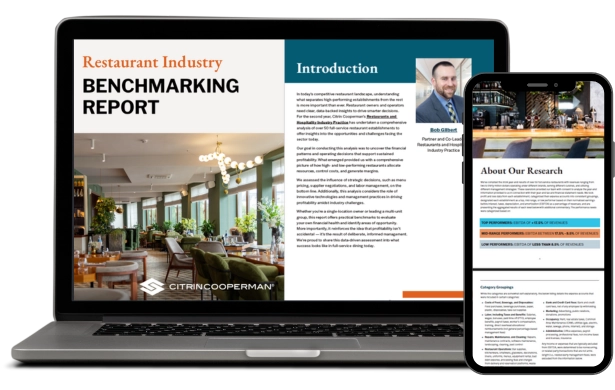
For more insights into the trends and challenges facing restaurants in today’s market, access our 2025 Restaurant Industry Benchmarking Report.
For the second year, Citrin Cooperman analyzed over 50 restaurants to determine the influence of strategic decisions, such as menu pricing, supplier negotiations, and labor management, on the bottom line.

Latest Articles

Cybersecurity Awareness Month: What to Do When Your Identity Is Stolen
Read More

Multi-Entity Accounting in QuickBooks: When Does It Make Sense to Take the Next Step?
Read More

5 Signs Your Business May Be Ready for the Next Step After QuickBooks
Read More