
Strategic Decisions for Successful Restaurants: Occupancy Costs



In today’s competitive landscape, understanding what separates high-performing restaurants from the others is more important than ever. Citrin Cooperman’s Restaurants and Hospitality Industry Practice has undertaken a comprehensive analysis of over 50 full-service restaurant establishments and assessed the influence of strategic decisions, such as occupancy costs, on the bottom line.
Occupancy costs have a significant impact on overall results. Some establishments have continued to creatively use outdoor space, which has worked out well for many. Other establishments don't have a customer base to operate for two or three meals per day and therefore cannot get the most of their space.
How the Top Performers Operate
Unlike many other strategic decisions explored in our assessment, occupancy costs are not "controllable expenses." That said, the top performers:
- Have solid working relationships with their landlords similar to a long-term business partnership.
- Get the most use of their space by efficient seating arrangements and outdoor dining.
- Communicate issues with their landlord timely.
- Negotiate aggressively when accommodations are necessary for the operation to survive.
How the Low Performers Operate
Restaurant owners don't lock themselves into leases expecting to pay 20% rent, so it’s typically revenue that needs the most focus and improvement. Low performers don't analyze costs that are more controllable, such as utilities, which could potentially be reduced via changing providers or investing in new equipment.
Trends
Occupancy costs for restaurants are trending upward, driven by rising base rents, property taxes, and utility expenses across most major markets. Landlords have regained leverage post-pandemic, and lease renewals are often coming at significantly higher rates than those negotiated during the pandemic.
Restaurants in urban business districts — once reliant on steady weekday lunch traffic from office workers — are still adapting to hybrid workplace models that have reduced traditional daytime volume. As a result, many operators are reevaluating location strategies, negotiating for more flexible lease terms, or seeking mixed-use neighborhoods with more stable residential and evening traffic.
Explore the Restaurant Industry Benchmarking Report
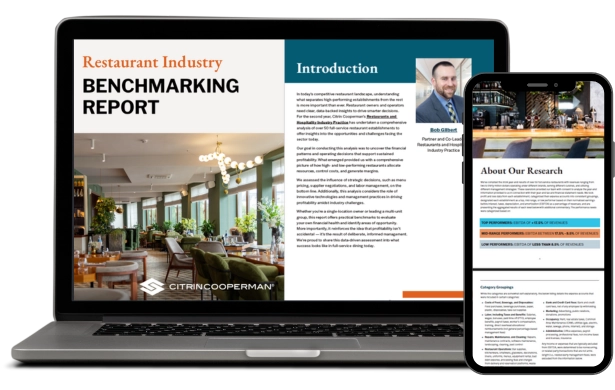
For more insights into the trends and challenges facing restaurants in today's market, access our 2025 Restaurant Industry Benchmarking Report.
For the second year, Citrin Cooperman analyzed over 50 restaurants to determine the influence of strategic decisions, such as menu pricing, supplier negotiations, and labor management, on the bottom line.

Latest Articles

The Hidden Cost of Spreadsheet Consolidation for QuickBooks Users
Read More

Getting EDI Right: Common Challenges in NetSuite Implementations
Read More

Visibility Powers Growth for Consumer Products Manufacturers
Read More

Don’t Take the Bait: Defending Against AI-Driven Phishing
Read More