
What Importers Need to Know About IEEPA Tariff Refunds: Protecting Your Rights and Maximizing Recovery



Following the Supreme Court's February 2026 ruling that invalidated the International Emergency Economic Powers Act (IEEPA) tariffs, importers now face critical decisions about securing refunds on billions of dollars in duties paid since April 2025. While the refund mechanics remain unresolved, importers must take immediate action to protect their rights and position themselves for potential recovery.
Citrin Cooperman’s Manufacturing and Distribution Industry Practice and Blue Tiger International hosted an informative webinar on Wednesday, February 25, titled "Negotiating IEEPA Tariff Refunds: Managing Your Responsibility" to discuss the essential steps every importer should take now. This article reviews the insights presented, explains available options for pursuing refunds, and addresses the most pressing questions facing businesses in this rapidly evolving situation.
Understanding the Supreme Court Ruling
In 2025, President Trump invoked IEEPA, a statute typically reserved for national security emergencies, to implement reciprocal tariffs on goods imported into the United States. The administration justified these tariffs by asserting that the U.S. faced economic, political, and military risks that required bypassing normal congressional approval processes. Several companies challenged this authority in the Court of International Trade (CIT) in New York, arguing the president had overstepped his constitutional bounds. The CIT ruled in favor of the plaintiffs, and the case advanced to the Supreme Court. On Friday, February 21, 2026, the Supreme Court upheld the CIT's decision, finding that the president exceeded his authority in implementing IEEPA tariffs.
The Supreme Court's decision had immediate consequences:
- IEEPA tariff collections ended at 12:00 AM on February 24, 2026
- Section 122 tariffs replaced IEEPA duties as the administration's alternative revenue mechanism at 12:00 AM on February 24, 2026
- The Court confirmed IEEPA tariffs are subject to reimbursement
- The Court did not address the specific mechanics of how refunds will be processed
Critically, the Supreme Court sent the refund process question back to the Court of International Trade for resolution. This means the specific procedures, timelines, and requirements for obtaining refunds remain uncertain.
Not all tariffs are affected by the Supreme Court's ruling. The following tariffs are not covered and remain in effect:
- Section 232 tariffs (steel, aluminum, and derivatives)
- Section 301 tariffs (China-related duties)
- Section 122 tariffs (the new 15% replacement tariffs effective February 24, 2026)
- Anti-dumping and countervailing duties
When reviewing your customs entries, focus on Chapter 99 classifications specifically associated with IEEPA duties. While customs entry forms (CBP Form 7501) would be simpler if one code represented all IEEPA tariffs, multiple Chapter 99 codes apply across different duty categories, making identification more complex.
Essential Actions Every Importer Must Take Now

1. Establish Your ACE Account with ACH Refund Capability
This is the single most critical action for all importers, regardless of IEEPA exposure.
Why it Matters: U.S. Customs and Border Protection (CBP) no longer issues refund checks. All refunds, whether from IEEPA protests, drawback claims, or duty overpayments, are processed exclusively through Automated Commercial Environment (ACE) accounts via Automated Clearing House (ACH) electronic transfers.
Action Steps:
- Establish an importer account in ACE (not just an export account)
- Configure ACH capability specifically for receiving refunds
- Verify your Employer Identification Number (EIN) is correctly associated with your account
- Ensure your banking information is current and accurate
Important Notes:
- ACE account setup involves significant verification processes and can take time
- The ACE support team in Washington handles requests for the entire country, creating potential delays
- Setting up ACH for refunds does not require establishing ACH for duty payments
- Your ACE account provides access to all entries cleared under your EIN, regardless of which customs broker filed them
2. Identify and Document Your IEEPA Duty Payments
Generate Comprehensive Reports: Once your ACE importer account is established, run reports to identify all entries on which IEEPA tariffs were paid. These reports will show:
- Entry numbers and dates
- IEEPA duty amounts by entry
- Liquidation status for each entry
- Total IEEPA duties paid across all entries
Organize Your Records: Federal regulations require importers to maintain import records for five years. Ensure you have:
- Copies of all entry summaries showing IEEPA duty payments
- Commercial invoices and supporting documentation
- Proof of payment records
- Communication with customs brokers regarding IEEPA classifications
Coordinate with Customs Brokers: If you work with multiple customs brokers or use express consignment services (FedEx, UPS) for some shipments, remember that each broker can only report entries they filed. Your ACE account provides the complete picture across all entry types under your EIN.
3. Review Liquidation Dates
Understanding liquidation status is essential because it determines which refund strategies are available to you.
Liquidation Basics:
- Liquidation is CBP's final determination of an entry's classification and value
- Standard liquidation occurs 314 days from the entry date (unless extended or suspended)
- Once liquidated, you have 180 days to file a protest
- Entries not yet liquidated require different approaches
Strategic Options for Pursuing IEEPA Refunds
Importers have several potential avenues for recovering IEEPA duties. The best approach depends on your entries' liquidation status, your risk tolerance, and the resources you're willing to commit.
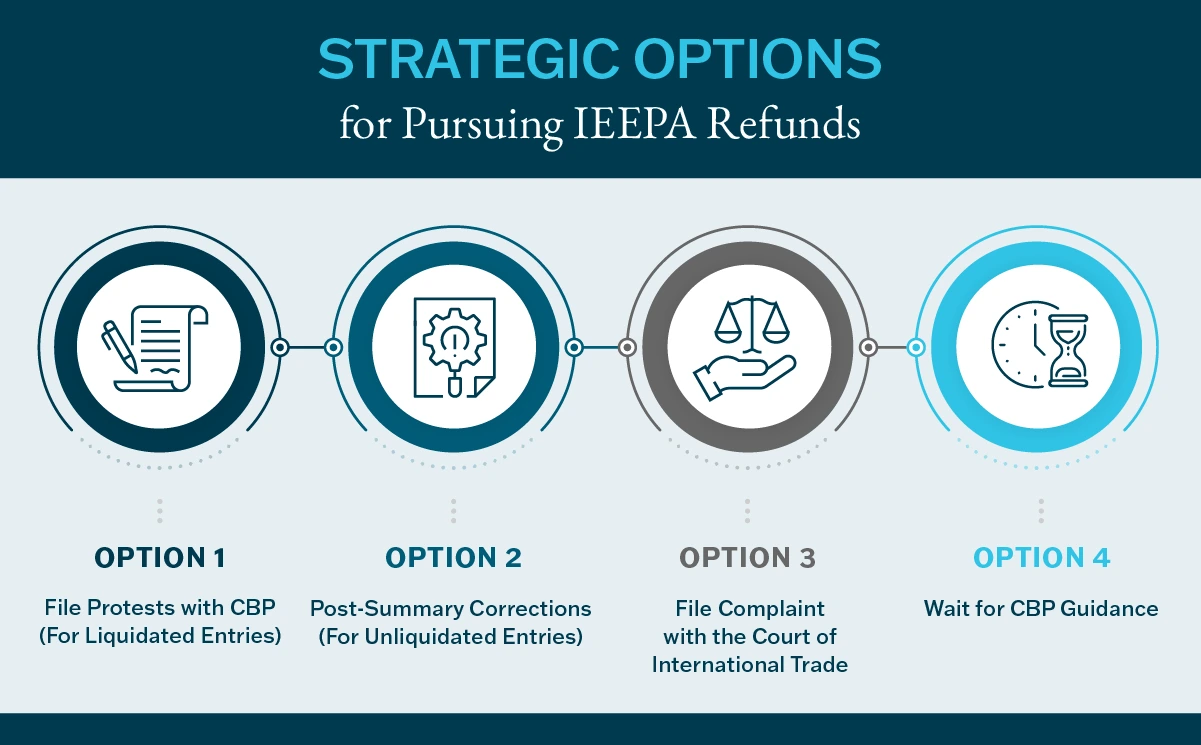
Option 1: File Protests with CBP (For Liquidated Entries)
What It Is: A formal protest challenges CBP's assessment of duties on a liquidated entry.
When to Use: Your entry has liquidated, and you paid IEEPA duties on that entry.
Timeline: Must be filed within 180 days of the liquidation date.
How to Implement:
- Establish a protest account in ACE (in addition to your importer account)
- File protests yourself through your ACE portal, or
- Engage your customs broker to file on your behalf (expect fees)
Current Status: Before the Supreme Court ruling, CBP routinely denied IEEPA protests, stating there was no valid basis for protest. However, these denials created an official record of the dispute. Post-ruling, protests can now cite the Supreme Court's determination that IEEPA tariffs were unlawful, significantly strengthening the legal foundation.
Advantages:
- Establishes formal record with CBP of your refund claim
- "Dots your i's and crosses your t's" for legal purposes
- Can be filed independently without attorney involvement
- Creates placeholder while refund mechanics are resolved
Considerations:
- Customs brokers charge fees for protest filing services
- Processing times are uncertain, especially given the volume of expected protests
- May be automatically processed once CBP establishes refund procedures
Option 2: Post-Summary Corrections (For Unliquidated Entries)
What It Is: A mechanism to correct errors on customs entries before liquidation.
When to Use: Your entry has not yet liquidated, and you paid IEEPA duties on that entry.
How It Works: Post-summary corrections allow importers to fix mistakes on customs entries through their customs broker. Federal regulations require importers to exercise "reasonable care" and correct known errors. IEEPA tariffs assessed under unlawful authority could qualify as errors requiring correction.
Current Status: While specific CBP guidance on using post-summary corrections for IEEPA removal has not been officially published, trade compliance experts indicate this avenue may be available. Importers should work with customs brokers to determine feasibility for specific entries.
Timeline: Generally must be filed before liquidation occurs (approximately 314 days from entry date, though some entries liquidate earlier).
Option 3: File a Complaint with the Court of International Trade
What It Is: Legal action filed directly with the CIT to compel refund of IEEPA duties.
When to Use: For importers seeking maximum legal protection or those with significant IEEPA exposure.
Two Approaches:
- Hire a customs attorney to file a formal complaint
- File a complaint independently (self-filing is legally permitted, though complex)
Why Consider this Option:
Major importers like L'Oréal, Dyson, and Bausch + Lomb have already filed CIT suits regarding IEEPA refund claims. Filing with the CIT provides the strongest legal protection of your refund rights while the refund process remains uncertain. It demonstrates you've taken all available steps to preserve your claims.
Advantages:
- Strongest legal protection of refund rights
- Creates official court record of your claim
- May accelerate resolution if CIT establishes class-wide remedies
- Can be combined with CBP protest filing
Considerations:
- Legal fees if using an attorney
- More complex process for self-filing
- Time investment in preparing complaint documents
Option 4: Wait for CBP Guidance
What It Is: Taking no immediate action while awaiting official CBP refund procedures.
When to Consider: For importers with:
- Limited IEEPA duty exposure
- Preference to conserve resources rather than pursue proactive claims
- Confidence that CBP will implement automatic refund processes
The Rationale: CBP possesses complete data on which importers paid IEEPA duties and in what amounts. The agency could theoretically implement automatic refund procedures without requiring individual claims. However, given the unprecedented volume and dollar amounts involved, automatic refunds are far from certain.
Staying Informed in a Shifting Environment
Industry specialists estimate the Court of International Trade may not issue comprehensive guidance on IEEPA refund procedures until Q2 or Q3 of 2026 — potentially months away. Even after guidance is issued, processing the volume of refund claims will take additional time. This vague timeline reinforces why taking action now, despite uncertainty, is essential for protecting your refund rights.
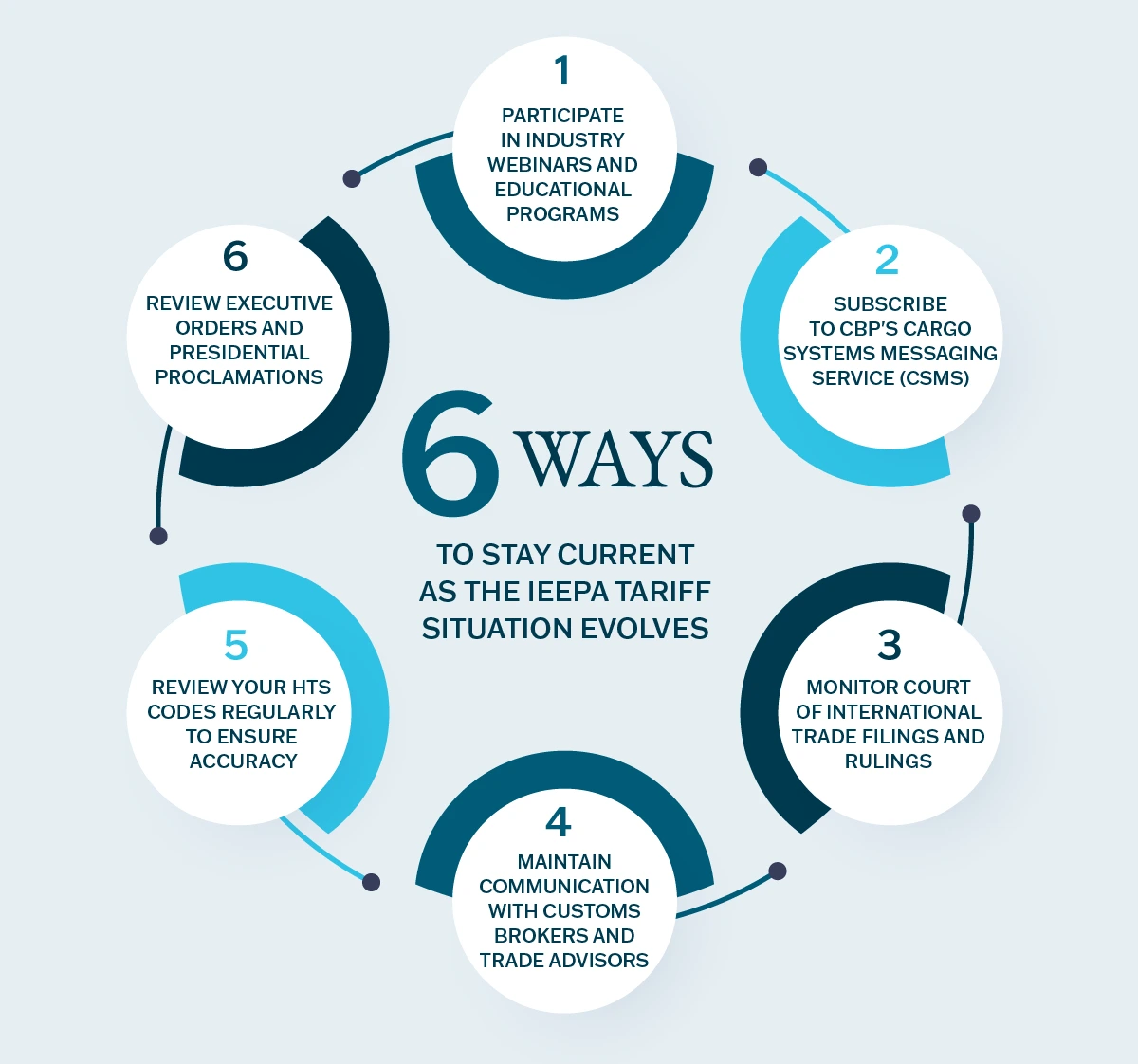
The IEEPA tariff situation continues evolving rapidly. To stay current:
- Subscribe to CBP's Cargo Systems Messaging Service (CSMS) for official updates
- Monitor Court of International Trade filings and rulings
- Maintain communication with customs brokers and trade advisors
- Participate in industry webinars and educational programs
- Review executive orders and presidential proclamations (noting these count as official policy even when issued via social media)[CA6.1]
- Review your HTS codes regularly to ensure accuracy
Explore Duty Mitigation Strategies
Several programs can reduce or defer duty payments:
- Bonded Warehouses: Defer duties until goods enter U.S. commerce; if exported, duties never apply
- Foreign Trade Zones (FTZ): Similar duty deferral benefits plus additional manufacturing advantages
- Drawback: Recover duties on imported goods that are subsequently exported
- Free Trade Agreements: Ensure you're claiming all applicable USMCA, CAFTA, and other preferential treatment
Be Prepared Amid Uncertainty
The Supreme Court's ruling that IEEPA tariffs were unlawful creates a potential refund opportunity measured in billions of dollars across the importing community. However, the path to recovering those funds remains undefined, and the timeline uncertain.
In this environment, waiting for complete clarity before acting poses significant risk. At minimum, every importer should:
- Establish an ACE account with ACH refund capability immediately
- Identify and document all IEEPA duty payments
- Track liquidation status for affected entries
- Evaluate which refund strategies align with your exposure and resources
While uncertainty remains, one principle is clear: protecting your rights requires action now, not after final guidance emerges. The importers best positioned for recovery will be those who document their exposure, establish the necessary accounts and procedures, and take appropriate steps to preserve their claims during this fluid period.
For questions about your organization's IEEPA exposure and refund strategy, reach out to John Giordano or Mark Henry.


Latest Articles

The Hidden Cost of Spreadsheet Consolidation for QuickBooks Users
Read More

Getting EDI Right: Common Challenges in NetSuite Implementations
Read More
Visibility Powers Growth for Consumer Products Manufacturers
Read More

Don’t Take the Bait: Defending Against AI-Driven Phishing
Read More