
Economic Outlook: What’s Next for Independent Sponsors?
By Citrin Cooperman’s Transaction Advisory Services Practice


In March and April 2025, we surveyed respondents on their outlook for the independent sponsor sector, including deal sourcing, valuations, and competition over the next year. Since then, the macroeconomic landscape has shifted significantly, amid worries about the labor market, inflation and the imposition of import tariffs.
In light of those changes, we present the survey findings from March and April alongside updated insights from our more recent conversations with contributors. While some earlier concerns have eased, persistent economic challenges and ongoing policy uncertainty continue to cast a shadow over the sector’s near-term trajectory.
“The macro environment is really the biggest question mark for all of us,” underscored Caroline Dallas, director, GEM.
“All bets are off at this point in many areas,” noted Richard Baum, managing partner, Consumer Growth Partners. “The market has temporarily seized up for any company directly impacted by tariffs. Very few deals are getting done in the public or private sector if tariffs are involved. The deals that are getting done are those where the impact of tariffs is minimal, or service-based businesses,” he added.
However, as our contributors noted, there are pockets of opportunity for independent sponsors, even in these uncertain times.
“In this uncertain economic climate, there may be opportunities for independent sponsors even within industries hit by tariffs because they are dealing with smaller businesses that are more localized and not as reliant on debt to make an outsized return,” said Chelsea Celistan, principal, Avante Capital.
“That’s another thing that we love about the independent sponsor space in addition to the insulation from some broader macroeconomic factors: it’s really an operations-first approach to improving a business, not just a financial engineering exercise,” she explained.
“LPs are asking GPs to exit and generate DPI (Distributed to Paid-In Capital) from their longer dated portfolio companies, say vintage 2014 to 2021,” noted Tarrus Richardson, founder and CEO, IMB Partners. “These exits are going to produce lower-than-expected returns, particularly in the large and mega-cap PE portfolio company exits where valuations have come down meaningfully,” he forecasted. “The lower middle market is not experiencing the run up or run down in valuations as much so the market is both more active and delivering solid returns in this current market, which is good news for independent sponsors.”
Several contributors expect capital allocators will increasingly invest on a deal-by-deal basis – which would benefit independent sponsors – and shift away from investments in blind pool structures.
“We don’t see a scenario where the capital allocators want to return to more blind pool funds,” advised Jeffrey Ennis, partner, Ocean Avenue Capital Partners. “There’s been an evolution away from that. We expect more pension plans, foundations and endowments will do more co-investing internally and may start to do some independent sponsor investing internally.”
“I think we will see more committed structures from institutional LPs where they’ll allocate $50 million for a strategy and sponsors will go through their vetting process,” Thomas Ince, managing partner, LP First Capital, explained.
Other contributors predict the rise of committed equity structures to fund independent sponsor transactions. “I think we’ll see more groups like Align Collaborate enter the space, and I think that’s a really great thing for independent sponsors because equity is hard to come by,” said Logan Lowery, managing partner, LP First Capital. “These groups will put more pressure on SBICs and will allow independent sponsors to put less leverage on closing transactions.”
As a general matter, many respondents and contributors expect more investors will enter the sector, seeking access to lower-middle-market transactions, for which independent sponsors are uniquely positioned.
As we saw in our 2020 Independent Sponsor Report: COVID-19, Weathering the Storm, while economic turbulence brings challenges, it also brings unique opportunities for those independent sponsors who are resilient and adaptable.
“Many companies have taken a hard hit which may lead to some compelling investment opportunities,” said Jacques Youssefmir, partner, Ocean Avenue Capital Partners. “That can create a strong pipeline of potential deals for independent sponsors who have a special situations background.”
“We are optimistic about the path ahead for the independent sponsor asset class,” stated Sylvie Gadant, managing partner, Citrin Cooperman’s Transaction Advisory Services Practice. “As we’ve seen in our 2020 Independent Sponsor Special Report, independent sponsors have risen to meet unprecedented challenges before, and we have no doubt they will continue to do the same in this uncertain climate.”
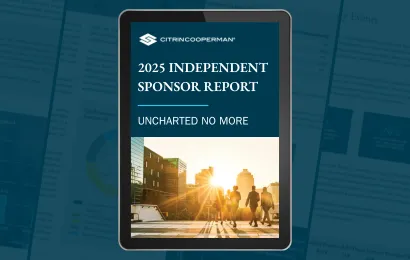
Citrin Cooperman’s 2025 Independent Sponsor Report
Latest Articles

The Hidden Cost of Spreadsheet Consolidation for QuickBooks Users
Read More

Getting EDI Right: Common Challenges in NetSuite Implementations
Read More

Visibility Powers Growth for Consumer Products Manufacturers
Read More

Don’t Take the Bait: Defending Against AI-Driven Phishing
Read More